
Key Takeaways
📱 Foundation Models framework provides access to the on-device language model
📌 ML-Powered APIs assist in complex tasks for specific use-cases
🍺 You can bring your own model to device
💻 MLX helps you tune and train models on Apple Silicon
Presenters
Jaimin Upadhyay, Core ML
Platform Intelligence
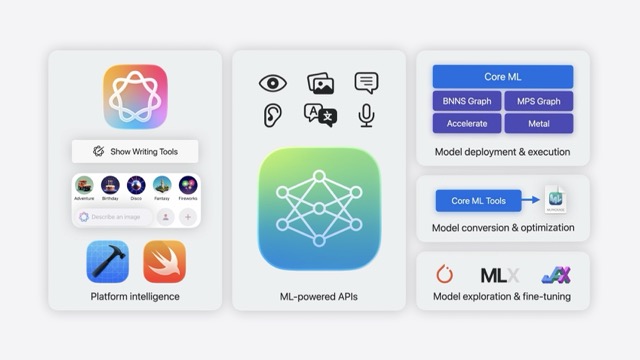
ML and AI are used through the platform to provide powerful features and experiences
A wide range of ML-powered APis are available to provide functionality in your app
Foundation Models framework allows apps to access the on-device language model
ML-Powered APIs
| Framework | Use |
|---|---|
| Vision | Understand the content of images and videos |
| Natural Language | Identify language, parts of speech, and named entities in natural language text |
| Translation | Perform text translations between multiple languages. |
| Sound Analysis | Recognize many categories of sound |
| Speech | Identify and transcribe spoken words in audio |
| Foundation Models | Access to an on-device language model specialized for everyday tasks |
Image Generation
Image Playground Framework provides SwiftUI extensions to bring up the
imagePlaygroundSheetImageCreatorallows you to create images programmatically
import ImagePlayground

let creator = try await ImageCreator()

let images = creator.images(
   for: [.text("A cat wearing mittens.")],
   style: selectedStyle,
   limit: 4
)

for try await image in images {
   doStuff(with: image.cgImage)
}
Smart Reply
Allows users to choose generated smart replies for messages and emails.
The context must be donated to the keyboard to use Smart Reply
let context = UIMailConversationContext()
context.entries = ...

...

entryField.conversationContext = context

...

func textField(_ :UITextField, insertInputSuggestion inputSuggestion: UIInputSuggestion) {
   ...

   entryField.text = generateLongForm(from: inputSuggestion)
}
Foundation Models Framework
Provides programmatic access to a highly optimized on-device language model specialized for everyday tasks
User’s data stays private and doesn’t need to be sent anywhere
No cost to developers or users
Features work offline
import FoundationModels

let session - LanguageModelSession()

let response = try a wait session.respond(to: "Tell a joke")
Structured Responses
Foundation Models framework can provide structured responses within your app
Mark types as
@Generableto allow Foundation Models framework to generate the typeUse
@Guideto provide natural language guides for properties
let prompt = "Generate a list of suggested search terms for an app about visiting famous landmarks."

let response = try await session.respond(
   to: prompt,
   generating: SearchSuggestions.self
)

@Generable
private struct SearchSuggestions {
   @Guide(description: "A list of suggested search terms", .count(4))
   var searchTerms: [SearchTerm]
}

@Generable
struct SearchTerm: Identifiable, Equatable {
   @Guide(description: "A unique id", .pattern(\search-term-\(d/))
   var id: String

   @Guide(description: "A 2-3 word search term, like 'Beautiful sunsets'")
   var content: String
}
Tool Calling
The foundation model data is fixed in time and does not contain recent events
Tool calling let you provide additional data to the model
Tools can take real actions, in your app, on the system, or in real world.
Vision
Includes 30 APIs for different types of image analysis
New APIs
Document Recognition can group document structures making it easier to process and understand documents
Lens Smudge Detection helps identify smudges on a camera lens
Speech
SFSpeechRecognizerworks well for short-form dictation
New APIs
SpeechAnalyzersupports many more use cases and is run completely on deviceA new speech-to-text model that is faster and more flexible
ML Models
All previously mentioned APIs access models built into the system
Any model can be brought to the device in a Core ML format.
A collection of open models in the Core ML format is available on developer.apple.com
MLX provides access to state-of-the-art models and the ability to fine tuning and train on Apple Silicon machines.
