
Key Takeaways
🎼 Analyzes audio entirely on device
🥁 Six dimensions: key, rhythm, structure, pace, instruments, loudness
⚡️ Request only the analysis types you need
📊 Music Understanding Lab sample visualizes all of them
Presenters
Conner Richardson, Computational Music
Musical features
Music Understanding analyzes a song across six dimensions, the building blocks of the framework
Key, Rhythm, Structure, Pace, Instrument activity, Loudness
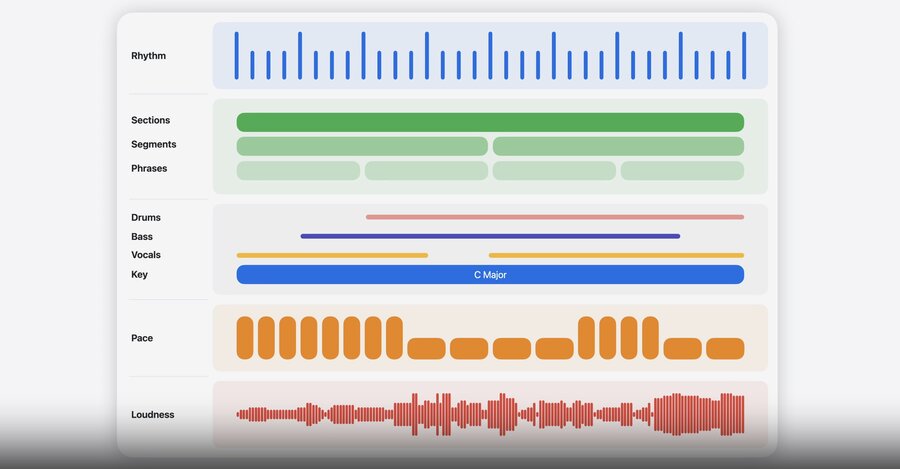
Rhythm: pulse of a song, driven by individual beats
Beats build into bars
Number of beats in one minute is beats per minute (bpm)
Structure: three levels of hierarchy, built up from the rhythm
Phrases: bars form phrases, which are musical sentences
Segments: phrases combine into segments, creating a more complete musical statement
Sections: segments build the sections, like a chorus, verse, intro, or bridge
Instrument activity: instruments such as drums, bass, or vocals playing at different times and at different intensities
Key: common set of notes those instruments play around, for example C major
Pace: how fast a part of the song feels
Song can have a consistent pulse or bpm, but different parts may feel slower or faster
Loudness: song may sound louder at some points than others
Framework overview
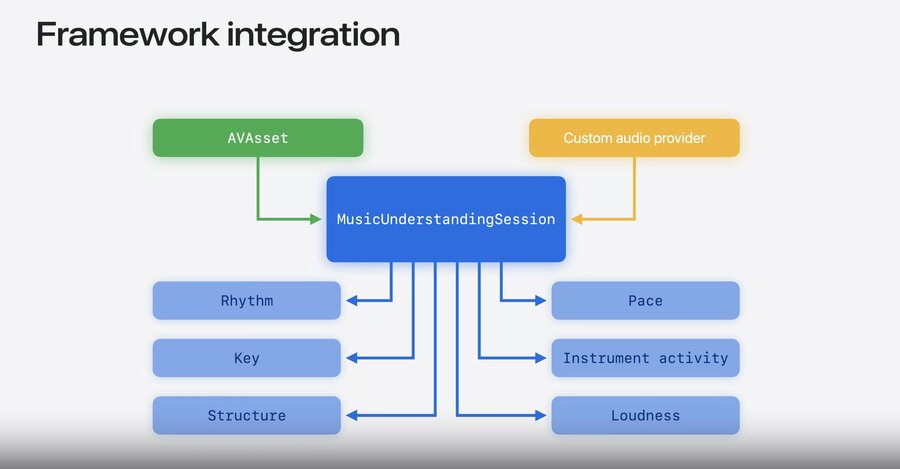
Apps interact with
MusicUnderstandingSessionat a high levelInitialize with either an
AVAssetor a custom audio providerTo start analysis, call
analyze()and await resultsEverything runs on device, so analyzed audio stays private and works offline
Framework analyzes for all analysis types by default
For highest performance, use
analyze(for:)to specify theAnalysisTypes you are interested in and avoid unnecessary computations
Session is single use. Call
analyze()only once per instance and create a new session for another pass
Initialize the session
import MusicUnderstanding

.fileImporter(isPresented: $isPresented, allowedContentTypes: [.audio]) { result in
    switch result {
    case .success(let url):
        let asset = AVURLAsset(url: url,
                               options: [AVURLAssetPreferPreciseDurationAndTimingKey : true])
        let session = try await MusicUnderstandingSession(asset: asset)
        let results = try await session.analyze()
    }
}
Set
AVURLAssetPreferPreciseDurationAndTimingKeytotruefor most accurate results
Results
All results are contained in a
SessionResultstructEvery analyzed feature gets its own results field, all optionals
public struct SessionResult: Codable, Sendable {
    public let instrumentActivity: InstrumentActivityResult?
    public let key: KeyResult?
    public let loudness: LoudnessResult?
    public let pace: PaceResult?
    public let rhythm: RhythmResult?
    public let structure: StructureResult?
}analyze()populates all resultsanalyze(for:)only returns what you asked for and leaves the restnilTwo standard types associate time with values throughout the framework:
TimedValue<Value>: value at aCMTimeinstantRangedValue<Value>: value over aCMTimeRange
All results are
Codable. Encode session results with aJSONEncoderto get JSON
API features
1. Key
One
rangesentry per detected key, so a song that changes key reports more than one
public struct KeyResult: Codable, Sendable {
    public let ranges: [MusicUnderstandingSession.RangedValue<KeySignature>]
}
Key signature pairs a
tonic, the root note, with amode, major or minor
public struct KeySignature: Codable, Hashable, Sendable {
    public let tonic: Tonic
    public let mode: Mode
}

@frozen public enum Tonic: String, Codable, Hashable, Sendable {
    case aFlat, aSharp, a, bFlat, b, c, cSharp, d, dFlat, dSharp, eFlat, e, f, fSharp, g, gFlat, gSharp
}

public enum Mode: String, Codable, Hashable, Sendable {
    case major, minor
}
2. Rhythm
Gives the timestamp of every beat and bar as arrays of
CMTimeAlso provides the overall tempo with
beatsPerMinute(optional)
public struct RhythmResult: Codable, Sendable {
    public let beats: [CMTime]
    public let bars: [CMTime]
    public let beatsPerMinute: Float?
}
3. Structure
Supports three levels: sections, segments, and phrases
Each of them comes back as an array of
CMTimeRange
public struct StructureResult: Codable, Sendable {
    public let sections: [CMTimeRange]
    public let segments: [CMTimeRange]
    public let phrases: [CMTimeRange]
}
4. Pace
One
rangesentry per stretch of the song, each carrying aDoubleHigher value means that part feels faster, no matter what the bpm is
public struct PaceResult: Codable, Sendable {
    public let ranges: [MusicUnderstandingSession.RangedValue<Double>]
}
5. Instrument activity
Both fields are keyed by
Instrument, so you look up one instrument at a timeranges: when the instrument is playingactivity: how prominent it is at each moment, from 0 to 1
public struct InstrumentActivityResult: Codable, Sendable {
    public let ranges: [Instrument: [CMTimeRange]]
    public let activity: [Instrument: [MusicUnderstandingSession.TimedValue<Float>]]
}
6. Loudness
integratedandpeakare single values for the whole songmomentaryandshortTermare series of values that follow the song over time
public struct LoudnessResult: Codable, Sendable {
    public let integrated: MusicUnderstandingSession.TimedValue<Float>
    public let momentary: [MusicUnderstandingSession.TimedValue<Float>]
    public let shortTerm: [MusicUnderstandingSession.TimedValue<Float>]
    public let peak: MusicUnderstandingSession.TimedValue<Float>
}
Also provides a streaming API for loudness
Loudness is the only feature with incremental delivery, one value per 100 ms of analyzed audio
public var loudnessResults: some AsyncSequence<LoudnessResult, any Error> & SendableWorking with audio and results
Audio Provider
AudioProviderconforms toAsyncSequenceand yieldsAVReadOnlyAudioPCMBufferobjects
struct AudioProvider: AsyncSequence, AsyncIteratorProtocol {
    func makeAsyncIterator() -> Self {
        return self
    }

    mutating func next() async -> AVReadOnlyAudioPCMBuffer? {
        // Return the next audio buffer, or nil to signal completion
    }
}
Encode to JSON
All MusicUnderstanding results are codable
import MusicUnderstanding

let session = try await MusicUnderstandingSession(asset: asset)
let results = try await session.analyze()

let encoder = JSONEncoder()
try encoder.encode(results)
Ideas from the session
Sync visuals to beat, loudness, or pace in a video editing feature
Organize a music catalog by tempo or key in a DJ app
Pre-compute and bundle analysis data to animate a game to the music
Sample code: Creating visuals with Music Understanding analysis results
