
Summary
Dynamic Profiles empower context management and model orchestration.
Introduce Foundation Models framework utilities for building agent experiences.
Patterns include “baton-pass” and “phone-a-friend” for agent orchestration.
Customize tool calling modes and manage session transcripts.
Evaluate performance impacts using the new Xcode Instruments.
Presenters
Erik Hornberger, Swift AI Frameworks
Oliver O’Neill, Apple Intelligence Platform
Dynamic Profiles Overview
Dynamic Profiles: Allow context management and model boundary definition.
APIs: Enable switching between models and configurations within
LanguageModelSession.
Key Features
Foundation Models Framework Utilities: Open source Swift package for agentic experiences.
Profiles: Configurations with instructions, tools, and modifiers.
Dynamic Instructions: Group relevant tools and instructions; composable for reuse.
// DynamicInstructions

struct BrainstormFacilitator: DynamicInstructions {
   var orchestrator: CraftOrchestrator
   var body: some DynamicInstructions {
         Instructions {
            "You are a warm and friendly expert crafting brainstorm facilitator."
         }
         // Tools
         GenerateProjectTitle()
         // Conditionally include Origami knowledge
         if orchestrator.techniques.contains(.origami) {
            OrigamiExpert()
         }
   }
}
// DynamicProfile
struct CraftProfile: LanguageModelSession.DynamicProfile {
var orchestrator: CraftOrchestrator
var body: some DynamicProfile {
switch orchestrator.mode {
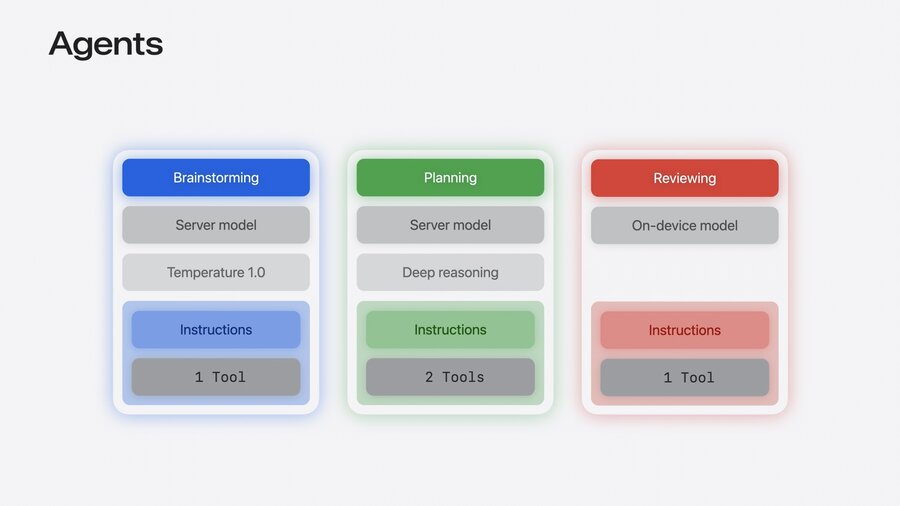
case .brainstorming:
Profile { BrainstormFacilitator(orchestrator: orchestrator) }
.model(orchestrator.pccLanguageModel)
.temperature(1)
case .planning:
Profile { TutorialAuthor(orchestrator: orchestrator) }
.model(orchestrator.pccLanguageModel)
.reasoningLevel(.deep)
case .reviewing:
Profile { CraftCoach() }
.model(orchestrator.systemLanguageModel)
}
}
}// Initialize your session with your dynamic profile
let session = LanguageModelSession(profile: CraftProfile(orchestrator: orchestrator))Session Management
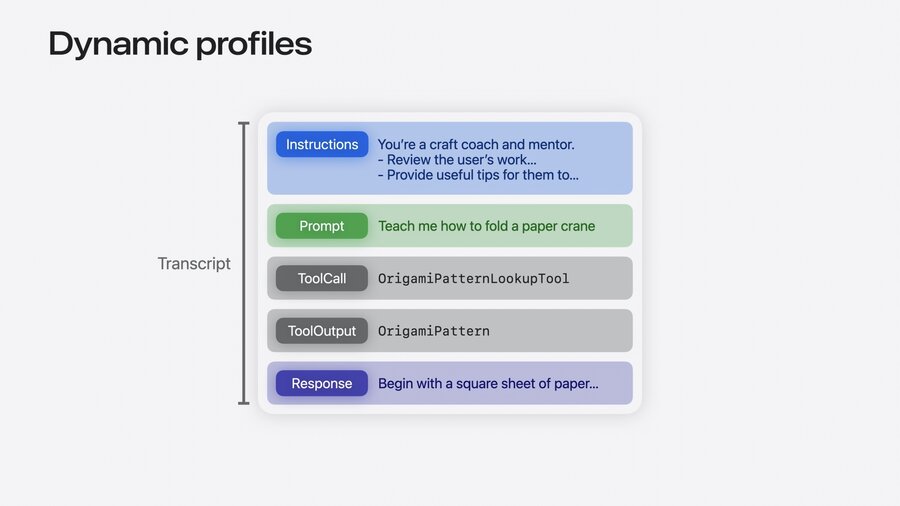
Transcript Management: Use
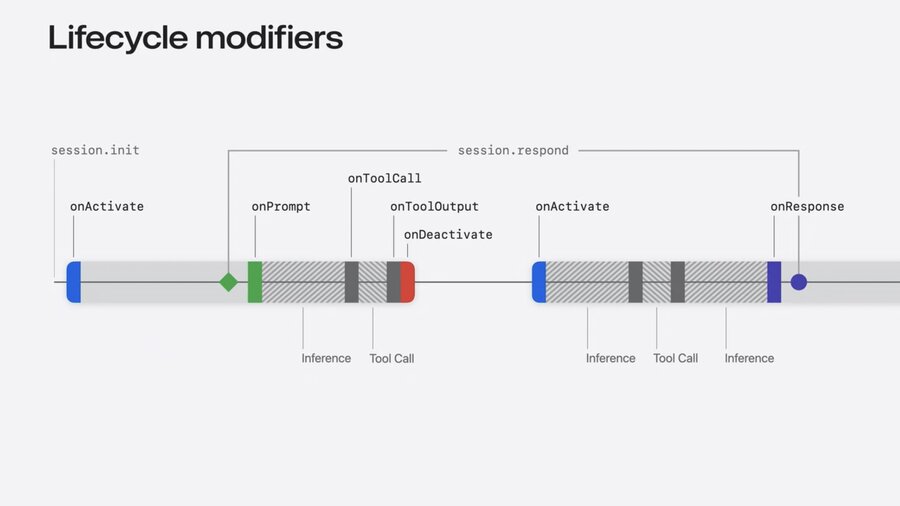
historyTransformand custom modifiers to adjust model context.Lifecycle Modifiers: Execute code at session lifecycle points, e.g.,
onResponse.Session Properties: Define state shared across session components.
// Transcript management

struct CraftProfile: LanguageModelSession.DynamicProfile {
   var orchestrator: CraftOrchestrator
   var body: some DynamicProfile {
         switch orchestrator.mode {
         case .reviewing:
            Profile { CraftCoach() }
               .model(orchestrator.systemLanguageModel)
               .historyTransform { history in
                     // Update the history for your profile
                     guard let latestResponseIndex = lastResponseEntryIndex(history) else {
                        return history
                     }
                     let filteredHistory = history[0..<latestResponseIndex].filter { entry in
                        isToolCallsOrToolOutput(entry)
                     }
                     return filteredHistory + history[latestResponseIndex...]
               }
         }
   }
}
// Custom modifiers
struct DroppingToolCallsProfileModifier: LanguageModelSession.DynamicProfileModifier {
func body(content: Content) -> some DynamicProfile {
content
.historyTransform { history in
guard let latestResponseIndex = lastResponseEntryIndex(history) else {
return history
}
let filteredHistory = history[0..<latestResponseIndex].filter { entry in
isToolCallsOrToolOutput(entry)
}
return filteredHistory + history[latestResponseIndex...]
}
}
}
extension LanguageModelSession.DynamicProfile {
func droppingCompletedToolCalls() -> some DynamicProfile {
self.modifier(DroppingToolCallsProfileModifier())
}
}// History management modifiers
import FoundationModelsUtilities
struct CraftProfile: LanguageModelSession.DynamicProfile {
var orchestrator: CraftOrchestrator
var body: some DynamicProfile {
switch orchestrator.mode {
case .reviewing:
Profile { CraftCoach() }
// Keep the most recent 10 entries
// after dropping finished tool calls
.rollingWindow(size: .entries(10))
.droppingCompletedToolCalls()
}
}
}// Lifecycle modifiers
struct CraftProfile: LanguageModelSession.DynamicProfile {
@SessionProperty(\.history) var history
var orchestrator: CraftOrchestrator
var body: some DynamicProfile {
switch orchestrator.mode {
case .planning:
Profile { TutorialAuthor(orchestrator: orchestrator) }
.model(orchestrator.pccLanguageModel)
.reasoningLevel(.deep)
.onResponse {
// Update history
if history.count > 50, let responseIndex = lastResponseIndex(history) {
history = history[responseIndex...]
}
}
}
}
}Agent Orchestration Patterns
Baton-pass: Collaboration between profiles with shared transcript history.
Phone-a-friend: Consultation with isolated transcripts for each session.
// Baton-pass

struct CraftProfile: LanguageModelSession.DynamicProfile {
   var orchestrator: CraftOrchestrator
   var body: some DynamicProfile {
         switch orchestrator.mode {
         case .brainstorm:
            Profile {
               BrainstormInstructions()
               BatonPassTool()
            }
            .onToolCall { orchestrator.mode = .tutorial }
            .model(orchestrator.serverModel)
         case .tutorial:
            Profile {
               TutorialInstructions()
               BatonPassTool()
            }
            .onToolCall { orchestrator.mode = .brainstorm }
            .model(orchestrator.systemModel)
         }
   }
}
// Phone-a-friend
struct CraftProfile: LanguageModelSession.DynamicProfile {
var body: some DynamicProfile {
Profile {
BrainstormInstructions()
PhoneFriendTool(
name: "generate_title",
description: "Generate a creative project title",
profile: TitleProfile()
)
}
}
}
struct PhoneFriendTool<P: LanguageModelSession.DynamicProfile>: Tool {
func call(arguments: GeneratedContent) async throws -> String {
let session = LanguageModelSession(profile: profile())
let response = try await session.respond(to: arguments)
return response.content
}
}Tool Calling Mode
Modes:
allowed,disallowed,requiredfor controlling tool call behavior.Error Handling: Use
transcriptErrorHandlingPolicyto manage transcript state after errors.
// The skills pattern

struct CraftingSkills: LanguageModelSession.DynamicInstructions {
   var activations: SkillActivations
   var body: some DynamicInstructions {
         Skills(activations: activations) {
            Skill(
               name: "origami_folds",
               description: "Details about specific types of folds",
               prompt: """
                     Valley Fold: Paper is folded toward you, creating a V-shaped crease
                     Mountain Fold: Paper is folded away from you, creating an inverted V
                     ...
                     """
            )
            Skill(...)
            Skill(...)
         }
   }
}
// Tool calling mode
public struct ToolCallingMode: Sendable {
public static let allowed: ToolCallingMode
public static let disallowed: ToolCallingMode
public static let required: ToolCallingMode
}
// Pass tool calling mode as a profile modifier
struct OrigamiExpert: LanguageModelSession.DynamicProfile {
var body: some LanguageModelSession.DynamicProfile {
Profile {
Instructions("You are an origami expert")
QueryOrigamiDatabaseTool()
ShowDirectionsTool()
}
.toolCallingMode(.required)
}
}
// Or pass it as a generation option
let response = try await session.respond(
to: "Write out the instructions for folding a paper crane.",
options: GenerationOptions(toolCallingMode: .required)
)// Escaping a tool call loop
struct OrigamiExpert: LanguageModelSession.DynamicProfile {
let state: OrigamiAppState
var body: some LanguageModelSession.DynamicProfile {
Profile {
Instructions("Answer questions about how to fold origami")
QueryOrigamiDatabaseTool()
}
.toolCallingMode(state.queriedDatabase ? .disallowed : .required)
.onToolCall { state.queriedDatabase = true }
}
}Performance Considerations
KV Caches: Affected by transcript mutations; measure using Xcode Instruments.
Evaluation Framework: Use for optimizing context engineering strategies.
Recommendations
Sample App: Experiment with new APIs and Xcode Instrumentation.
Evaluations: Create eval sets to measure context strategy impacts.
