
On device model personalization
Previously only bundles in the app
Apple has intentionally avoided trying to load models from the cloud as this compromises privacy and scalability
Provide some new training examples and receive a new model
Demo uses pencil kit to capture input drawing and find a emoji. With the new API the user can train the model to understand the user’s way of drawing.
Import an editable CoreML model this model has some parameters for updating declared
CoreML generates some classes to work with these inputs
To update:
Load the model from the bundle
Prepare the training data
Create an MLUpdateTask which async produces a CoreML model
We can update the model in the background. iOS will give you up to several minutes (see notes on the background tasks framework)
In short, Core ML 3 lets us update the model entirely locally (ad-hoc for the given user).
What’s inside a MLmodel
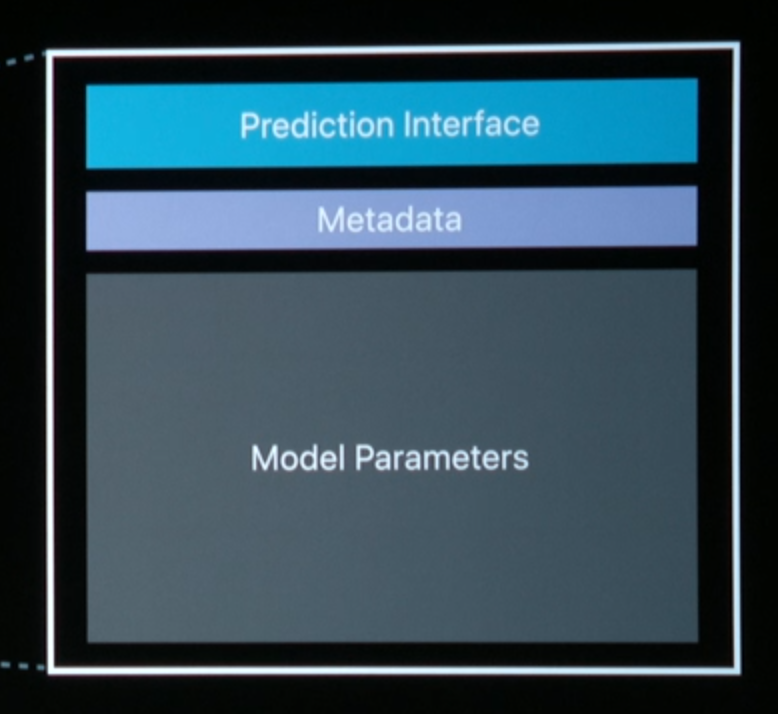 | 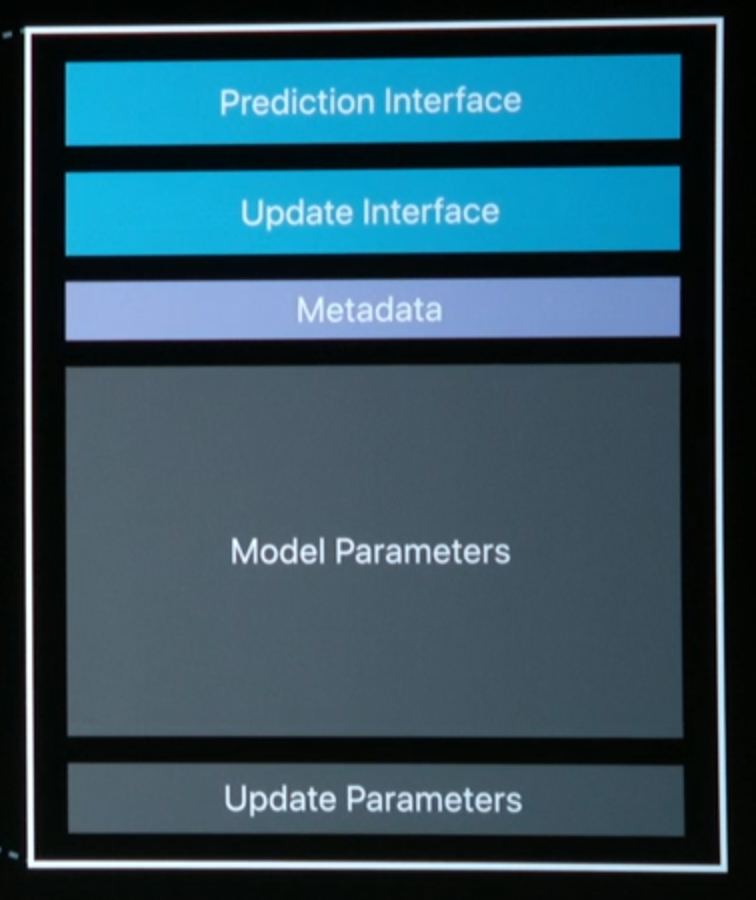 |
|---|---|
| Core ML 2 | Core ML 3 |
In CoreML 2 models consist mostly of:
Parameters: things like the weights of the layers, if it’s a neural network for example
Metadata: licensing and authors
Interface: describes how our app can interact with this model.
What’s new on CoreML 3:
Update parameters: describes what parts of the model are updatable and how it’s updatable.
Update Interface: model interface our app can leverage to make these updates happen.
Neural Networks
Neural networks are great at solving challenging task, such as understanding the content of an image or a document or an audio clip.
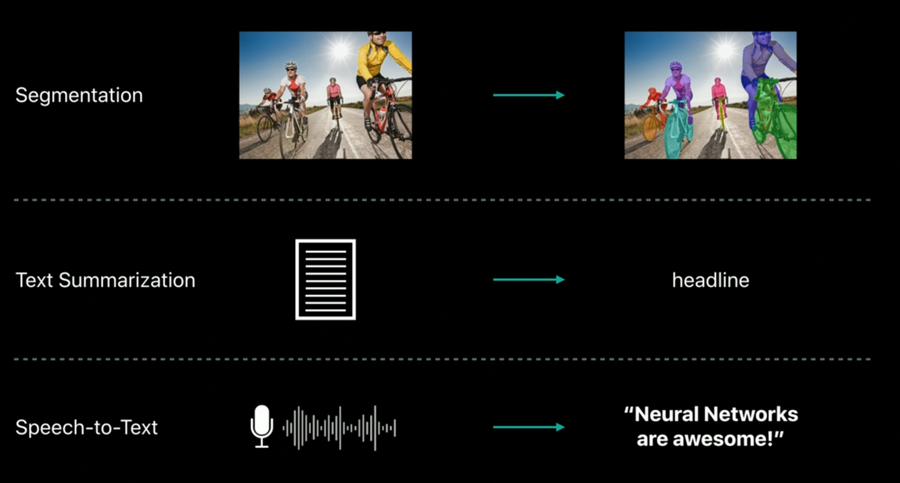
Core ML 3 has more advanced features available for Control flow in Neural Networks (e.g. Branching, Loops)
Internal improvements: Made existing layers more generic, control flow, add new mathematical operations
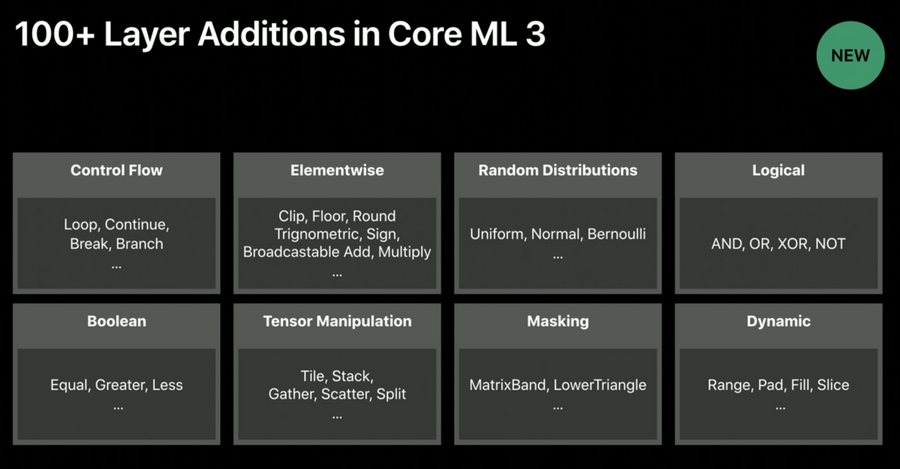
BERT in depth
BERT (Bidirectional Encoder Representation from Transformers) is state of the art machine learning model.
The BERT model is actually a neural network that can perform multiple tasks for natural language understanding.
Inside the BERT model there are a bunch of modules.
And inside these modules there are a bunch of layers.
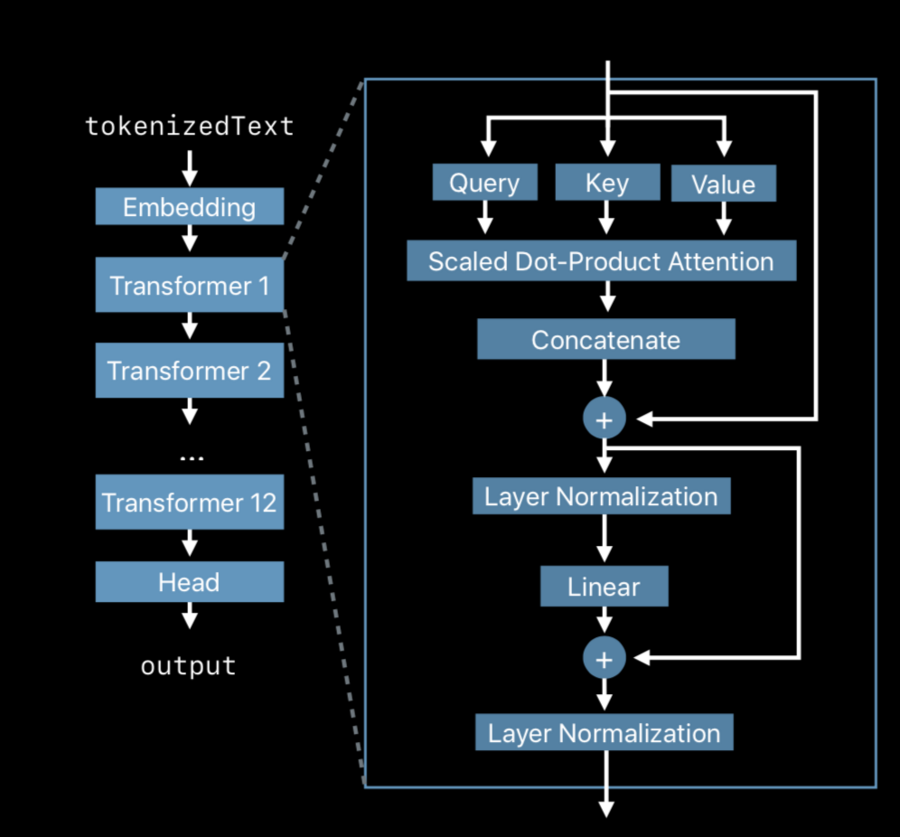
(Models on the left, layers on the right)
In short this is what’s happening behind the scenes of the demo:
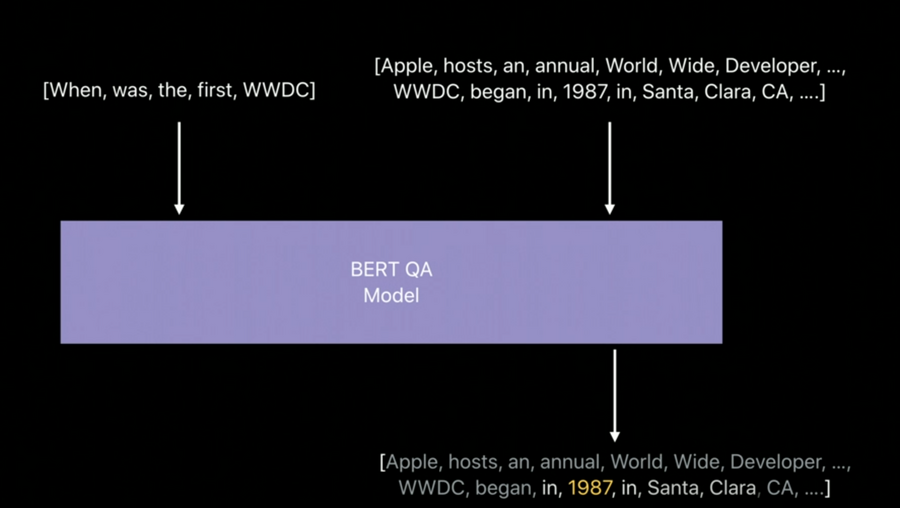
Other improvements
Linked Models: Shared models between pipelines.
Image Features: now images (from url, or
CGImageSource) are supported for models rather than just pixel buffers.MLModelConfigurationcan set preferred MetalDevice (use full for multi GPU env) and an option to speed up the performance of the GPU calculations (at accuracy cost).
