
Key Takeaways
Every raw loop hides an algorithm, so replace it
Reach for the standard library first
The right algorithm fixes bugs and cuts complexity
Write algorithms as generic protocol extensions
Overview
Models, views, and controllers get lots of design attention, but the underlying work our apps do (the algorithms) rarely gets the same care
This session treats computation as a first-class citizen: identify the algorithms hiding in your code, then express them clearly
Goal, borrowed from Sean Parent: “No Raw Loops”
every time you write a loop, replace it with a call to an algorithm
if a fitting algorithm does not exist, write it yourself and move the loop into its implementation
Deleting the selection
Raw loops hide bugs
Running example: a vector drawing app, “Shapes”, where the user can delete the selected shapes
v1 loops
0..<countand callsremove(at:)on matches, but the array shrinks while we iterate over its old count, so it walks off the endv2 uses a
whileloop that recheckscount, but now two consecutive selected elements skip onethis bug is insidious because it hides unless a test happens to exercise it
v3 iterates in reverse, which is correct and clean, because we only touch the part of the array we have not changed yet
// v1: buggy, walks off the end as the array shrinks
for i in 0..<shapes.count {
    if shapes[i].isSelected {
        shapes.remove(at: i)
    }
}

// v2: rechecks count, but skips an element when two in a row are selected
var i = 0
while i < shapes.count {
    if shapes[i].isSelected {
        shapes.remove(at: i)
    }
    i += 1
}

// v3: correct and clean, but still hides a performance problem
for i in (0..<shapes.count).reversed() {
    if shapes[i].isSelected {
        shapes.remove(at: i)
    }
}
Complexity
Even the clean reverse loop is O(n²):
remove(at:)is O(n) (it slides the following elements) and runs up to n timesFine for a 10-20 element test, but it freezes when many shapes are selected (50² is 2,500 steps, 100² is 10,000)
O(n) vs O(n²): a linear algorithm may lose on small inputs but always wins as the problem grows, no matter how expensive its steps
The point is scalability, not absolute performance, and scalability is predictability for your users
Reach for the standard library
The standard library already has the right algorithm:
removeAll(where:)It reads like its intent and does the work in a single O(n) pass instead of O(n²)
shapes.removeAll(where: { $0.isSelected })Lesson: get familiar with the standard library, a suite of algorithms with documented meaning and performance characteristics
How removeAll(where:) works
removeAll(where:)is itself built from smaller algorithms, and looking inside shows why it stays O(n)Step 1:
halfStablePartitionmoves every element to remove into a suffix at the end, and returns where that suffix startsStep 2:
removeSubrange(suffixStart...)deletes that whole suffix in one shot
extension MutableCollection where Self: RangeReplaceableCollection {
    /// Removes all elements satisfying `shouldRemove`.
    ///
    /// - Complexity: O(n) where n is the number of elements.
    mutating func removeAll(where shouldRemove: (Element) -> Bool) {
        let suffixStart = halfStablePartition(isSuffixElement: shouldRemove)
        removeSubrange(suffixStart...)
    }
}halfStablePartitiondoes the real work with two indices in a single passimarks the slot where the next element to keep should gojscans forward, and wheneverself[j]is a keeper it is swapped intoi, theniadvanceselements to remove are simply left behind, so they pile up at the end
“half stable” means the kept elements keep their relative order, while the removed ones may be scrambled (they are about to be deleted anyway)
extension MutableCollection {
    /// Moves all elements satisfying `isSuffixElement` into a suffix of the collection,
    /// returning the start position of the resulting suffix.
    ///
    /// - Complexity: O(n) where n is the number of elements.
    mutating func halfStablePartition(isSuffixElement: (Element) -> Bool) -> Index {
        guard var i = firstIndex(where: isSuffixElement) else { return endIndex }
        var j = index(after: i)
        while j != endIndex {
            if !isSuffixElement(self[j]) {
                swapAt(i, j)
                formIndex(after: &i)
            }
            formIndex(after: &j)
        }
        return i
    }
}
Reordering the selection
bringToFront is really a partition
Reordering commands (bring to front, send to back, bring forward, send backward) work on multiple, possibly non-contiguous selected shapes that must stay grouped afterward
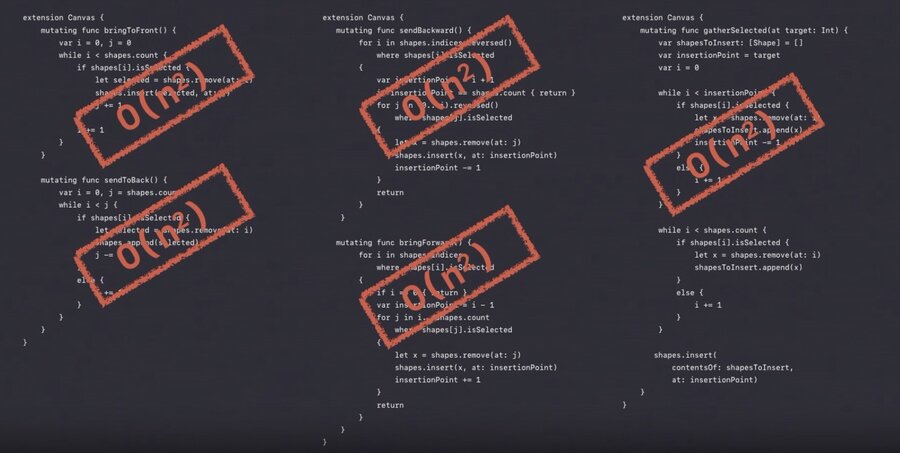
bringToFrontwas written as an O(n²) loop ofremove(at:)+insert(at:)Describing it in words (“move the selected shapes to the front, keeping their relative order”) reveals it is exactly
stablePartitioninvert the predicate to get
sendToBackstablePartitionis O(n log n), which stays close to O(n) as the problem grows
// Before: an O(n) loop containing O(n) operations, so O(n²) overall
extension Canvas {
    mutating func bringToFront() {
        var i = 0, j = 0
        while i < shapes.count {
            if shapes[i].isSelected {
                let selected = shapes.remove(at: i)
                shapes.insert(selected, at: j)
                j += 1
            }
            i += 1
        }
    }
}
// After: one stablePartition, moving the unselected shapes to the back
mutating func bringToFront() {
    shapes.stablePartition(by: { !$0.isSelected })
}

// Invert the predicate to send the selected shapes to the back
mutating func sendToBack() {
    shapes.stablePartition(by: { $0.isSelected })
}bringForwardis the samestablePartition, but applied to a slice (just the relevant portion of the array)
// Partition only the slice from the shape just before the first selected one to the end
mutating func bringForward() {
    guard let first = shapes.firstIndex(where: { $0.isSelected }),
          first > shapes.startIndex else { return }
    let start = shapes.index(before: first)
    shapes[start...].stablePartition(by: { !$0.isSelected })
}
Make it generic
Ask what the operation really has to do with the domain, then strip away each assumption (“what does
bringForwardhave to do with shapes? with arrays? with integer indices?”)decouple from the
Canvas, generalizeArraytoMutableCollection, and replace “is selected” with a generic predicate parameter
Work in terms of indices, not integers: a slice’s indices do not start at
0, they keep the indices of the collection they came from, which is exactly what lets generic algorithms compose over slices
// Compare against startIndex and step with index(before:), never 0 / i - 1
if predecessor > startIndex {
    let before = index(before: predecessor)
}
Needing “the index before the first match” becomes its own small algorithm (e.g.
indexBeforeFirst), so keep focus by assuming it already exists, then write it
How stablePartition works
stablePartitionuses divide and conquer: partition the left and right halves, thenrotatethe middle to bring the two matching groups togetherrotateis its own elegant, reusable algorithm living in the same file, and it powers many higher-level algorithms
The payoff
The messiest, buggiest code (dragging shapes within the list, with a temp buffer and several loops) turns out to be just two
stablePartitioncalls with inverted predicates, collapsing to a two-linerSeeing past domain detail to the fundamental computation is a learned skill that takes practice
Compose, document, and test
We build towers of abstraction and rely on lower layers without re-reading them precisely because they are documented, so document each algorithm’s semantics and complexity
Generic algorithms are more reusable, clearer, and easy to test with simple values (integers) instead of full app objects
Treat computation as a first-class citizen: identify it, give it a name, unit-test it, and document it
As Crusty puts it, “Programming reveals the real”
