
Core concepts
NSOperationQueueWrapper around dispatch queue
Makes it easy to cancel operations that have not began executing
Lets us specify the max number of concurrent operations, can be changed later (if
max == 1, this becomes a serial queue)
NSOperationWrapper around a dispatch block
can run several minutes (dispatch blocks too, but it’s not the expected behavior for those)
subclassable
NSOperation Lifecycle
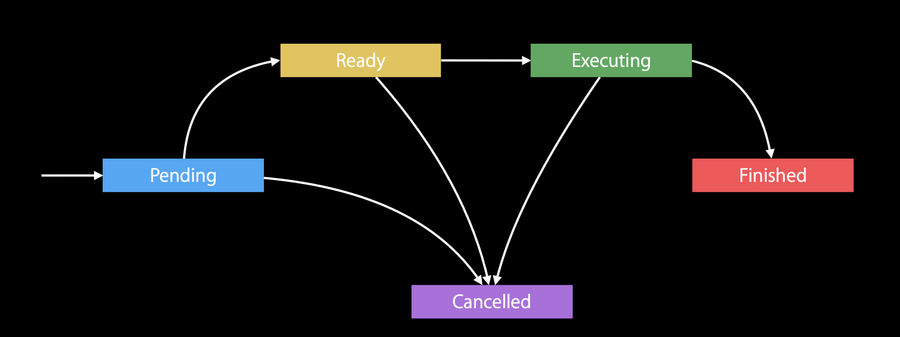
Once created the operation starts in a pending state
After putting it in its queue, the state will move to ready to execute
Then the operation queue at some point will fetch the operation and begin executing it.
After the execution finishes, the state will move to finished
At any point, the operation state can also move to cancelled (unless it has finished already)
NSOperation Cancellation
defined as a boolean (cancelled) in the
NSOperationobject.When we cancel an operation, what the system does is set this boolean
Up to us (or our subclass) to decide what does it mean for the operation to be cancelled
Up to us to observe changes in this boolean value and react on it
Note that there might be scenarios when the cancellation event comes too late and the operation finished before the event reaches the object
NSOperation Ready state
Again, defined as a boolean (ready).
Reflects that the operation is ready to execute
NSOperation dependencies
Strict ordering
By default an operation becomes ready only when all its dependencies have been executed
Not limited by operation queues: an operation can depend on operations in different operation queues
Be aware of deadlocks! (No mutual dependencies)
Beyond the basics
If an operation has dependencies, let that operation create by itself those operations:
this way we don’t need to create every time multiple levels of dependencies by ourselves, but strictly the dependencies needed by us, and they will take care of everything else. This is super powerful especially for reusabilityIt’s ok to add UI things inside the operations
It’s ok to have dispatch blocks inside the operations
Add requirements:
user location
User logged in
Internet availability
These requirements can be reflected by the ready state
Composing Operations
We can also create operations that internally have other operations,
e.g. an object request can be composed by a file download and a file parse
e.g. fetch all favorites the internal operation is a loop of fetches that continue until we fetch all the favorites (in case they’re paginated)
Mutual exclusivity
